|
||||||
|
||||||
|
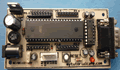
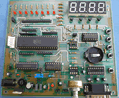
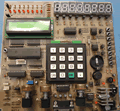
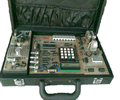
Microcontroller Kits Simple
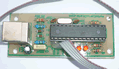
Mikrokontroller 89s51 Trainer All Item Include
|
3.1. Timer/ Counter Mode 0 : 13 bit Counter
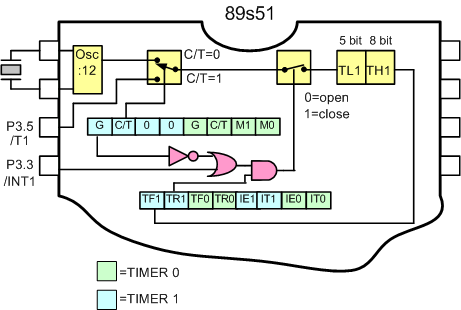
Putting either Timer into Mode 0 makes it look like an 8048 Timer, which is an 8-bit Counter with a divide-by-32 prescaler. Figure 7 shows the Mode 0 operation as it applies to Timer 1. In this mode, the Timer register is configured as a 13-bit register. As the count rolls over from all 1s to all 0s, it sets the Timer interrupt flag TF1. The counted input is enabled to the Timer when TR1 = 1 and either GATE = 0 or INT1 = 1. (Setting GATE = 1 allows the Timer to be controlled by external input INT1, to facilitate pulse width measurements). TR1 is a control bit in the Special Function Register TCON (Figure 8). GATE is in TMOD.
Figure 3.1. Timer/Counter Mode 0: 13-Bit Counter The 13-bit register consists of all 8 bits of TH1 and
the lower 5 bits of TL1. The upper 3 bits of TL1 are indeterminate and
should be ignored. Setting the run flag (TR1) does not clear the registers.
Mode 0 operation is the same for the Timer 0 as for Timer 1. Substitute
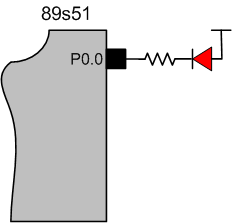
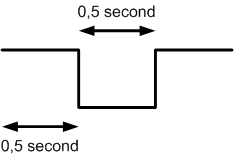
TR0, TF0, and INT0 for the corresponding Timer 1 By using Timer function, we can design a pulse generator and outputs data to port. as you see on figure 3.3.1., with frequency 1 Hz Step 1st Step 2nd
Figure 3.1.1. A pulse generator from timer function
Figure 3.1.2. Pulse Periode 1 second This program initialized counter/timer 1 to be a timer
operating in mode 0, that is a 13 bit timer. When the timer overflows,
the hardware sets the flag TF1. The program spends most of its time checking
whether the timer overflow flag TF0 is set. Note that in this mode, with
a 12 MHz crystal frequency, the timer overflows every 8192 microseconds.
       Org 0h
Start: Setb P0.0  ;P0.0 = 1
       call Delay ;call delay time
       Clr P0.0   ;P0.0 = 0
       Sjmp Start ;Looping Forever
;
Delay: Mov R0,#0       ;R0 = 0
       Mov TMOD,#00000000b ;mode 1, Timer 1
Load:  Mov TH1, #00Ch  ;TH1 = D8h
       Mov TL1, #078h  ; TL1 = F0h
       Setb TR1        ; TR1 = 1, Start Running
OFlow: JNB TF1, OFlow  ; jump to OFlow if  TF1 =0
       Inc R0          ; R0 = R0+1
       CJNE R0,#100,Load;
       Ret
;
       End
Step 3rd Comments, questions and discussion about this topic
|
|
||||
    |
||||||